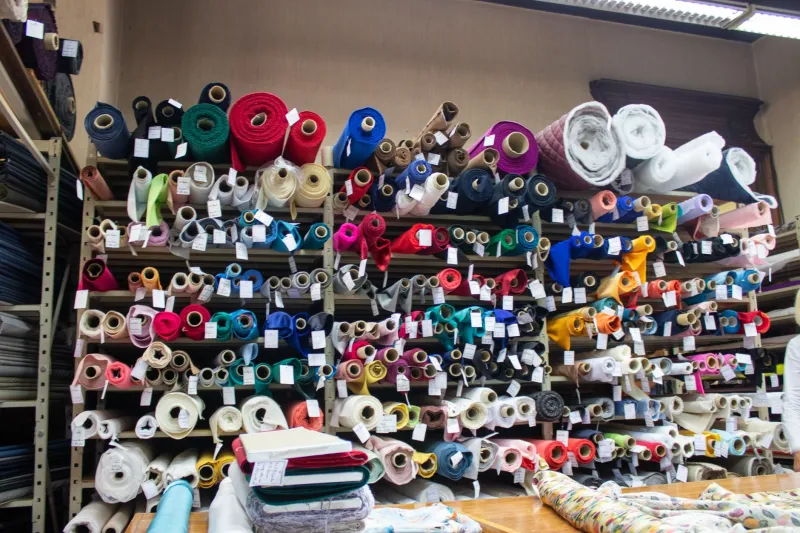
Seven Ways Emerging Labels Can Negotiate Fabric Orders Like an Established House

Photo by Photo by Vitaly Gariev on Unsplash on Unsplash
Walk into a mill negotiation with a $40,000 order against a competitor's $400,000 commitment, and it's easy to feel the playing field tilt against you. But volume isn't the only currency in the fabric trade. Predictability, speed of payment, and low administrative burden all carry value — and smaller brands are often better positioned to offer them than large houses locked into annual contracts and procurement committees.
Here are seven moves that consistently level the field, along with the warning signs that a supplier's "flexibility" will cost you more than it saves.
1. Sell the Repeat, Not the Order
Mills and wholesalers plan capacity around continuity. A single order is a transaction; a dependable quarterly program is an asset.
Script: "We're starting at 800 yards, but our plan calls for this fabric across three seasons. If the first delivery performs, we'll commit to a standing quarterly reorder — can we discuss what pricing looks like at that volume, with the first order as our proof point?"
This reframes a small opening order as an audition for a program. Most suppliers will sharpen a pencil for predictable revenue.
2. Propose Split Deliveries
If you can't meet an MOQ in one season, offer to take the full quantity across two or three releases. The supplier books the full sale; you match inventory to actual sell-through.
Script: "We can commit to your 3,000-yard minimum if we take it as 1,500 now and 1,500 in twelve weeks. Same price, same terms — does that work with your production calendar?"
Red flag: A supplier who agrees to split deliveries but demands payment in full upfront has transferred all inventory risk to you while keeping none themselves. That's not flexibility; that's a cash-flow trap.
3. Buy Off-Season Capacity
Fabric production, like fashion, has a calendar. Mills in August and wholesalers in January are hungry. Ordering your F/W program's core fabrics in the spring lull — or booking next summer's cottons in November — routinely unlocks 5 to 15 percent better pricing and priority in the production queue.
Script: "We're willing to commit early for fall delivery. What can you do on price if we place the order this month?"
4. Consolidate Your Buy With One Supplier
Splitting a modest budget across four vendors makes you a small account everywhere. Concentrating it makes you a meaningful account somewhere.
Script: "We're currently sourcing twill, canvas, and a linen blend from three suppliers. If you can cover all three, we'd consolidate — roughly 2,200 yards combined. What does that do to our pricing and freight terms?"
Bundling also reduces your own freight and admin costs — a rare case where the efficient choice and the leverage move are the same.
5. Negotiate Everything Except the Base Price
When a supplier won't move on per-yard cost, they may still have room on freight, payment terms, sampling fees, or deadstock allowances. Net-45 instead of net-30 on a $30,000 order is worth real working capital. Free strike-offs and lab dips save several hundred dollars per season. Freight absorbed by the supplier on a Los Angeles or Dallas delivery can be worth more than a 3 percent price cut.
Script: "I hear you on price — that's fair at this volume. Can we look at terms instead? Net-45 and you cover freight to our 3PL, and we can sign today."
6. Offer Fast Payment for a Discount
Small brands with healthy cash positions hold a card big companies can't play: speed. Offering payment on delivery — or a deposit at order — in exchange for 3 to 5 percent off is a trade many suppliers will take, especially from a new account they'd otherwise have to underwrite.
Red flag: If a supplier pushes aggressively for 100 percent upfront from a first-time customer, probe why. Demand references, a physical sample of the actual goods, and ideally a third-party inspection before funds move.
7. Ask for Their Problem and Solve It
The most underrated negotiation move is simply asking what the supplier needs. A wholesaler with excess of one colorway may offer it at a deep discount. A mill with a gap in its loom schedule may prioritize your job for faster turnaround.
Script: "Before we talk numbers — what's sitting heavy in your warehouse right now, or where do you have open capacity next month? If we can flex around that, I'd expect that flexibility reflected in the terms."
When Flexibility Is a Liability
Not every accommodation deserves a thank-you. Watch for these patterns:
- No minimums at all. A supplier who takes any order at any quantity is often a broker reselling others' inventory — with no control over dye lots, quality, or continuity. Your "flexible" reorder may not exist next season.
- Verbal agreements on specs. If a supplier resists putting strike-off approvals, fiber content, and shrinkage tolerances in writing, walk away. Flexibility in documentation usually means flexibility in what shows up.
- Prices that only go down for you and up for everyone. Deals far below market on in-demand fabrics frequently trace to seconds, expired dye lots, or misdeclared fiber content. Request test reports from an accredited lab before bulk commitment.
- Unwillingness to provide a roll-by-roll inspection report. Established suppliers expect this ask. Evasion is a signal.
The Long Game
Negotiation with fabric suppliers isn't a single conversation — it's a reputation built across seasons. The emerging label that pays on time, approves samples promptly, communicates forecast changes early, and orders with discipline becomes the small account that gets treated like a large one. In an industry built on relationships and repeat programs, that reputation compounds faster than any single discount ever could.