MOQ or Flexibility? How Fashion Brands Can Navigate Wholesale Order Quantities Without Sacrificing Margin
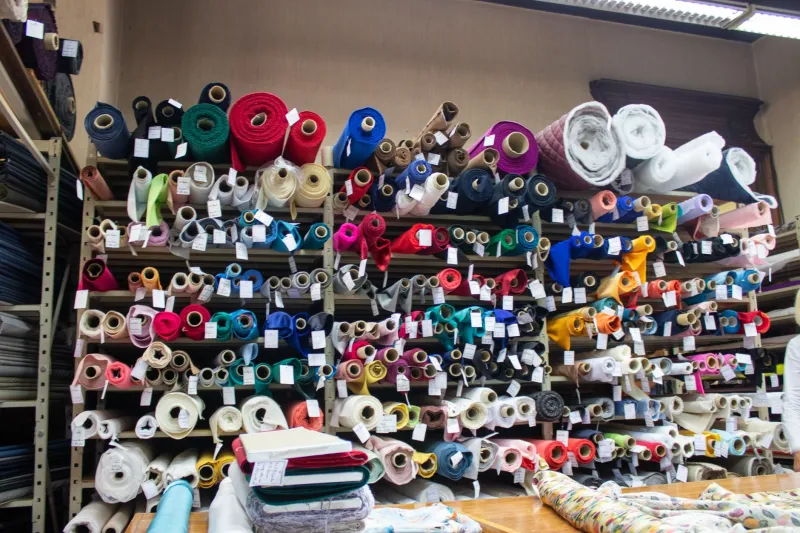
Every fashion brand eventually confronts the same uncomfortable arithmetic: the per-yard cost drops significantly at 500 yards, but you only need 200. Do you stretch the budget for the savings, or pay the premium and preserve working capital? This tension between bulk economics and production agility sits at the center of wholesale textile procurement strategy, and it rarely has a clean answer.
What follows is a structured examination of the trade-offs involved, organized around the decisions that emerging and mid-size US fashion brands most commonly face when negotiating with wholesale textile suppliers.
Understanding the True Economics of Bulk Purchasing
Minimum order quantities exist for a legitimate reason: textile manufacturing is a process-intensive business where setup costs, dye batches, and loom configurations are largely fixed regardless of yardage. Suppliers pass a portion of those fixed costs to buyers through MOQ structures, and the per-unit savings at higher quantities are genuine.
For brands with strong sell-through rates and stable demand forecasts, bulk purchasing can deliver meaningful margin improvement. Consider a fabric priced at $8.50 per yard at 100 yards and $6.75 per yard at 500 yards. On a 300-unit production run consuming 2 yards per garment, that differential represents $1,050 in material cost savings—before factoring in any freight consolidation benefit.
However, that calculation only holds if the inventory moves. Unsold garments manufactured from overstocked fabric represent a compounding loss: the cost of the excess material, the carrying cost of finished goods inventory, and the markdown risk that erodes realized margin at the point of sale.
When Small-Batch Purchasing Earns Its Premium
For brands in early growth stages, those testing new categories, or those operating in trend-sensitive markets, the premium paid for smaller yardage runs often represents sound financial management rather than inefficiency.
1. New Style Validation Before committing to a bulk fabric order for a new silhouette or category, producing a limited run—even at a higher per-yard cost—allows the brand to validate consumer response. The cost difference between a small-batch test and a bulk commitment is almost always lower than the cost of a failed bulk production.
2. Seasonal Trend Responsiveness Fashion brands operating in trend-driven categories face a structural challenge: the fabrics that are commercially relevant in one season may not be in the next. Smaller orders allow brands to rotate materials more frequently without accumulating obsolete yardage.
3. Cash Flow Management For brands without access to large revolving credit facilities, the capital tied up in bulk textile inventory has an opportunity cost. Preserving working capital for marketing, production labor, or operational needs may generate more enterprise value than the per-yard savings achieved through higher MOQs.
4. Sustainability Commitments An increasing number of US fashion brands are making public commitments to reduce material waste. Small-batch purchasing aligns operationally with those commitments by limiting overproduction at the source. For brands positioning around responsible manufacturing, this alignment has reputational value that partially offsets the cost premium.
Hybrid Arrangements: Negotiating a Middle Ground
The binary choice between bulk and small-batch is frequently a false one. Experienced buyers know that wholesale textile suppliers often have more flexibility than their published MOQ structures suggest—particularly for brands with consistent purchasing histories or growth trajectories that make them attractive long-term partners.
Blanket Orders with Release Schedules A blanket order commits to a total yardage quantity—qualifying for bulk pricing—while allowing the brand to take delivery in smaller scheduled releases. This structure gives the supplier production planning certainty while preserving the buyer's inventory management flexibility. The key negotiating variable is the release window: a 90-day delivery schedule is more supplier-friendly than a 30-day one.
Shared Inventory Programs Some wholesale suppliers offer inventory-holding arrangements in which the supplier warehouses a committed quantity of fabric and releases it against purchase orders as needed. This approach is more common with core materials than with fashion-forward fabrics, but it is worth exploring for staple textiles that appear consistently across multiple collections.
Tiered Pricing Agreements Rather than negotiating a single MOQ, brands can propose tiered pricing structures that reward cumulative annual volume rather than single-order quantity. A brand that purchases 2,000 yards of a given fabric across four seasonal orders may be entitled to bulk pricing retroactively or on a forward-looking basis, depending on the supplier relationship.
Matching Order Strategy to Brand Stage
There is no universally correct answer to the MOQ question, but there are stage-appropriate guidelines.
Brands generating under $1 million in annual revenue should generally prioritize flexibility over per-yard savings. The cost of a bad bulk bet at this stage can be existential. Brands in the $1 million to $5 million range are typically in a position to begin leveraging blanket orders and tiered pricing negotiations for their most consistent materials while maintaining small-batch purchasing for experimental categories. Brands above $5 million in revenue have the purchasing history and supplier leverage to negotiate meaningful hybrid arrangements across most of their material categories.
The Strategic View
Wholesale textile purchasing is not simply a procurement function—it is a capital allocation decision. The brands that navigate it most effectively are those that treat order quantity strategy with the same analytical rigor they apply to pricing, marketing spend, and production planning.
Garment Fabrics T works with fashion brands across the growth spectrum, offering MOQ structures and purchasing arrangements designed to accommodate the realities of modern apparel businesses. The right order quantity is the one that serves your margin, your cash flow, and your production calendar—not the one that simply looks most efficient on a per-yard basis.