The Forecasting Gap: How Fabric Misjudgments Drain Fashion Brand Margins

Of all the operational disciplines that separate financially resilient fashion brands from those perpetually squeezed by margin pressure, fabric forecasting may be the least glamorous and the most consequential. The decision of how much wholesale textile to order, and when, sits at the intersection of creative ambition, sales projection, and supply chain reality—a confluence that leaves enormous room for costly error in either direction.
Over-order, and a brand ties up working capital in idle inventory, incurs warehousing costs, and eventually faces the markdown math of liquidating excess fabric. Under-order, and the brand confronts stock-outs that delay production, alienate retail partners, and in the worst cases, force substitution with inferior or mismatched materials. Neither outcome is theoretical. Both play out across the US garment industry with regularity, and the cumulative financial impact runs into the millions for mid-size brands managing multiple collections annually.
Why Forecasting Fabric Is Harder Than Forecasting Product
Most fashion brands have some form of demand planning function, however informal, applied to their finished goods. Fabric forecasting operates upstream of that process and introduces a distinct set of complications.
First, fabric must be committed to—often months before production begins—based on sales projections that are themselves uncertain. A brand ordering wholesale textiles for a spring collection in October is making a bet on consumer demand that will not be validated until February or March. Any significant deviation between projected and actual sales creates a fabric mismatch.
Second, fabric is not a finished product. A yard of deadstock fabric that does not get cut into a garment has limited salvage value and essentially no consumer demand. Unlike overstock in finished goods, which can be discounted and sold through clearance channels, excess fabric inventory is difficult to monetize without either a secondary market relationship or the operational capacity to redirect it into new styles.
Third, supplier lead times create a fixed planning horizon that compresses the window for course correction. Brands sourcing from overseas wholesale textile suppliers may be operating on lead times of 90 days or longer. By the time early-season sales signals arrive, the fabric order is already in production or transit.
The Hidden Costs of Over-Ordering
Over-ordering fabric feels like a conservative choice in the moment—a hedge against stock-outs that seems prudent when a style is expected to perform well. In practice, it generates a cascade of costs that are rarely fully accounted for in the original planning model.
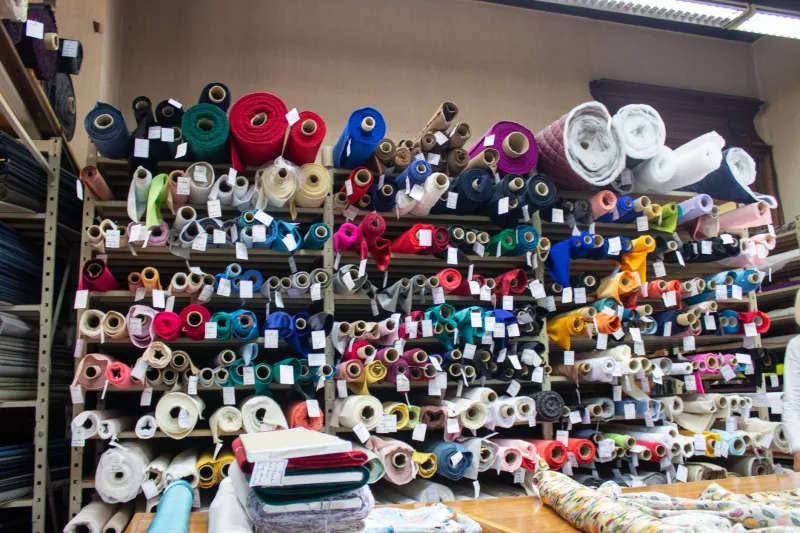
Warehouse space occupied by excess fabric is space unavailable for finished goods inventory. Capital tied up in idle textile inventory is capital unavailable for marketing, product development, or supplier deposits on the next collection. And when excess fabric eventually moves to liquidation—often at a fraction of the original wholesale cost—the write-down affects margins that were already thin.
For brands operating with seasonal collections, the problem compounds. Fabric ordered for a specific seasonal collection may not be usable in subsequent seasons if the material, color, or weight does not align with the next collection's direction. The result is a growing inventory of partially useful materials that represent sunk costs without forward value.
The Operational Reality of Stock-Outs
If over-ordering is the slow drain, stock-outs are the acute crisis. When a fashion brand runs short of a key fabric mid-production, the options are uniformly bad. Rush orders from wholesale textile suppliers typically carry premium pricing, expedited freight costs, and no guarantee of exact material match. Substituting an alternative fabric risks compromising fit, drape, or finish in ways that may not be apparent until the garment is complete. Delaying production to wait for additional fabric inventory puts retail delivery commitments at risk.
The downstream cost of a missed delivery window can be severe. Major US retailers impose financial penalties for late or incomplete shipments, and repeated fulfillment failures can jeopardize a brand's wholesale account relationship entirely. For direct-to-consumer brands, stock-outs translate directly into lost sales and potential customer attrition that is difficult to quantify but real in its impact.
Forecasting Tools and Methodologies Worth Adopting
Brands that have reduced their forecasting error rates meaningfully tend to share a few common practices. The first is the use of historical sell-through data as a baseline, adjusted for known variables—new distribution channels, marketing investment, category expansion—rather than relying on optimistic projections untethered from past performance.
The second is scenario planning. Rather than building a single fabric order quantity, disciplined brands model three scenarios: a conservative case, a base case, and an upside case. The fabric order is then structured to cover the base case with optionality built in—through supplier agreements—to call up additional yardage if early-season performance tracks toward the upside scenario.
A third practice is the adoption of open-to-buy frameworks applied to fabric purchasing, not just finished goods. Open-to-buy disciplines impose a structured relationship between planned sales, existing inventory, and new purchasing commitments that prevents the kind of speculative over-ordering that feels reasonable in isolation but is damaging in aggregate.
Negotiating Flexibility Into Supplier Agreements
The most effective forecasting strategy is only as good as the supplier relationships that support it. Brands that have invested in strong wholesale textile partnerships are better positioned to build flexibility into their ordering structures in ways that reduce the binary risk of over- or under-ordering.
Specific arrangements worth pursuing include blanket purchase orders with scheduled release windows—where a brand commits to a total yardage over a season but calls off fabric in increments aligned with actual production needs. Some wholesale suppliers will also agree to hold finished fabric inventory against a confirmed order, releasing yardage on shorter notice than standard production lead times would allow.
The negotiating leverage for these arrangements typically comes from volume consistency, payment reliability, and the length of the supplier relationship. Brands that have established themselves as dependable partners are in a meaningfully stronger position to request non-standard terms than those approaching a supplier as a transactional buyer.
Building a Culture of Planning Discipline
Ultimately, reducing fabric forecasting errors is as much an organizational challenge as a technical one. Brands where the creative, merchandising, and operations teams operate in silos—each optimizing for their own objectives—tend to produce fabric plans that reflect internal negotiation rather than market reality.
Brands that have brought these functions into genuine alignment, supported by shared data and a common planning cadence, consistently demonstrate tighter forecasting accuracy and lower inventory-related costs. The fabric order becomes a collective commitment rather than a number that one department imposes on another.
In an industry where margins are perpetually under pressure, the brands that master this discipline are not simply better at planning—they are structurally more profitable than those that treat fabric forecasting as an afterthought.